
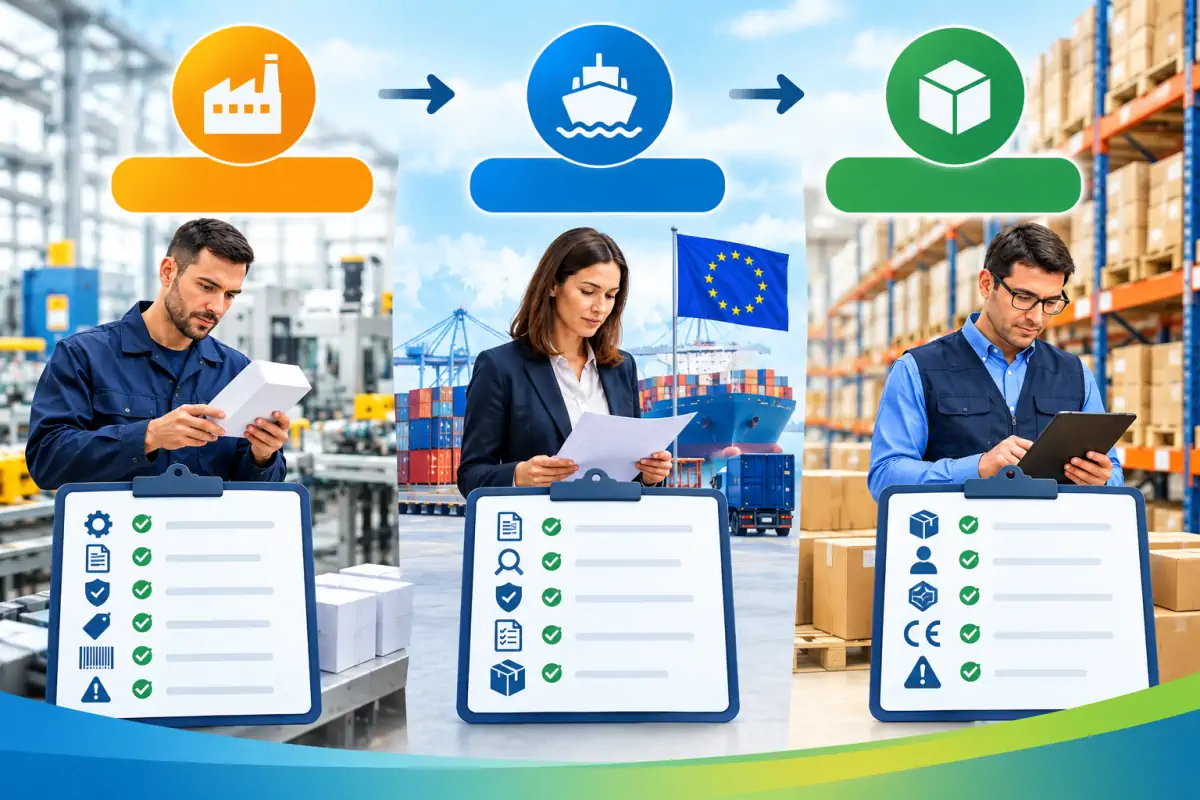
Manufacturer, importer, or distributor: a role error can change all responsibility
I still encounter companies that are unclear about their legal position within the supply chain.
Some consider themselves mere distributors because they buy a finished product. Others believe they are importers solely because they receive goods from outside the European Union. However, the name the company uses internally does not determine its responsibility.
What matters is what it actually does with the product and how it markets it.
The manufacturer is not always the one who physically produces it.
A company can be considered a manufacturer even if it has no factory.
This occurs, for example, when it markets a product under its own name or brand. If a European company buys a product manufactured in China and sells it under its brand, it can assume the legal obligations of the manufacturer.
In that case, it can no longer just say that the product was designed and produced by an external supplier. It must be able to demonstrate that:
- The product has been properly evaluated.
- There is sufficient technical documentation.
- Its risks have been identified and controlled.
- The labeling and warnings are appropriate.
- Its traceability can be carried out.
- There are procedures to act in case of accidents or claims.
The own brand is not just a business decision. It can also change the legal role of the company.
The importer must check, not just receive documents.
The importer is the company established in the European Union that introduces a product from a third country into the market.
Its function is not simply to transport, store, and sell.
Before marketing the product, it must check that the manufacturer has fulfilled its obligations and that the product meets the applicable requirements.
One of the most frequent mistakes is to accept a certificate or a test report without verifying:
- If it corresponds exactly to the product sold.
- If the model, components, and materials match.
- If the standard used is still applicable.
- If the photographs and references are correct.
- If the product received is identical to the tested sample.
The importer does not necessarily have to repeat all the manufacturer’s work, but must conduct reasonable checks and keep evidence of them.
The distributor also has obligations.
The distributor buys products that have already been introduced into the European market and makes them available to other distributors or consumers.
Although their obligations are different, they cannot act as a mere intermediary without responsibility either.
They must check, among other things, that the product:
- Is correctly identified.
- Includes the data of the responsible operators.
- Contains the necessary instructions and warnings.
- Displays the required marking.
- Shows no obvious signs of insecurity or non-compliance.
Furthermore, if they receive a serious complaint or detect a possible risk, they must communicate it and cooperate in corrective measures.
The same company can have several roles.
This is another point that often causes confusion.
A company may be a distributor for some products, an importer for others, and a manufacturer for those marketed under its own brand.
Therefore, it is not enough to define the company in general terms. The analysis must be done product by product and operation by operation.
The role can also change when the company modifies a product, alters a relevant characteristic, changes its intended use, or markets it under a new identity.
Conclusion
Incorrectly identifying the role of a company can lead to the absence of necessary documentation, inadequate checks, or improper actions in front of an authority.
The question should not only be: “Who physically manufactured the product?”.
The correct question is:
Who brings it to market, under what name is it sold, and what control does each company exercise over the product?
Answering correctly before starting to sell can prevent many problems later.

Leave a Reply